






















Sayama Tea Picking and Kawagoe Walk: A Day Between the Tea Hills and Little Edo
Pick fresh tea leaves at a 150-year-old Sayama plantation, then wander Kawagoe's atmospheric Edo-era streets.
Overview
Sayama is a hill country an hour northwest of Tokyo whose mineral soil and cool nights produce one of the most fragrant green teas in Japan, in production since the thirteenth century. The morning of this tour is spent at Miyano Plantation, a family garden founded in 1869 and still tended by the same line of tea makers, where you dress in the traditional tea girl costume, pick your own leaves, and learn the steaming-and-rolling rhythm that turns fresh harvest into sencha. A tasting of freshly fried tea leaf tempura with a self-serve cup of Sayama-cha closes the morning at the plantation.
The afternoon moves down to Kawagoe, the well-preserved Edo-period merchant town nicknamed Little Edo. Together with your English-speaking guide you walk the black-walled kurazukuri warehouse street, visit the Gohyaku Rakan stone disciples and the only surviving rooms of the original Edo Castle at Kita-in Temple, fish for an omikuji fortune at Hikawa Shrine, and close the day with a sake tasting at Koedo Kurari, a former brewery turned craft hall a short walk from Honkawagoe Station.
Details
❖ Meet at Iriso Station
09:30

Your day begins at the east entrance of JR Iriso Station at 09:30. From here a chartered private car carries you a short distance to Miyano Plantation, a family-run Sayama tea garden founded in 1869 and still tended by the same lineage of tea makers.
❖ Get ready and learn some tea-picking tips
10:00 - 10:15 (15 min)

At the plantation you are welcomed by Miyanoen's owner and dressed in the traditional tea girl costume worn by Sayama pickers for generations. A short briefing follows, covering which leaves to pick, where on the stem to break them, and the rhythm that produces the most fragrant first-flush tea.
❖ Tea Picking
10:20 - 10:50 (30 min)

You step into the open tea fields with a small basket and begin the harvest. Each group is given its own row of plants so the picking is unhurried, the air carries the scent of fresh leaves, and the slow movement of the pickers ahead of you sets the pace.

When your basket is full, Miyanoen's owner gathers everyone for a commemorative photograph taken with your phone, framed from the centre of the field with the tea hedges and the Sayama hills behind you.
❖ Tea Leaf Making
10:55 - 11:20 (25 min)

Back at the workshop, Miyanoen's owner walks you through the tea leaf making process. The leaves you picked are steamed at low temperature, then rubbed gently between palms in a rhythm repeated about ten times until they dry to the fine dark needles of finished sencha. As you work, you can ask the owner about Sayama's terroir, the family's history, and the differences between the season's flushes. The tea you make is yours to take home.
❖ Tasting Tea Leaf Tempura
11:20 - 11:40 (20 min)
Freshly fried tea leaf tempura arrives on a small plate, the leaves crisped just enough to release their grassy aroma, and a self-serve Sayama-cha and Hojicha machine lets you wash each bite down with the very tea you have been picking. The portion is a tasting, not a full lunch.
❖ Kita-in Temple
12:40 - 13:25 (45 min)
Kita-in Temple was founded in 830 by the priest Ennin and has long served as the head temple of the Tendai Buddhist sect in the Kanto region. After fire destroyed the original buildings in 1638, the third Tokugawa shogun Iemitsu had several rooms of his Edo Castle dismantled and reassembled here at Kita-in, where they remain today as the only surviving rooms of the original Edo Castle anywhere in Japan.

The temple gardens were laid out in the Edo style, with carp ponds, mossy stone lanterns, and a quiet wooden veranda overlooking a borrowed-view landscape. Walk slowly: the gardens are designed to draw the eye toward distant elements that fold into the foreground only as you move.

Beyond the main hall sit the Gohyaku Rakan, a grouping of 538 stone statues carved between 1782 and 1825 representing the disciples of the Buddha. Each face is different, some serene, some grimacing, some laughing or weeping, and a local tradition holds that the rakan whose face most resembles your own will share something of your character.
❖ Hikawa Shrine
14:35 - 14:45 (10 min)

Kawagoe Hikawa Shrine has presided over Little Edo for more than 1,500 years and is best known throughout Japan as a shrine of enmusubi, the binding of fortunate connections in matchmaking and love. The shrine houses five deities, two of which form married pairs, and singles seeking partners as well as long-married couples come here to pray for harmony and a long, prosperous marriage.

Step through the great torii at the front of the precinct, which at fifteen metres ranks among the tallest wooden torii in the country, and the inner grounds open up around the main hall with its cypress beams blackened by centuries of incense.

What sets Hikawa Shrine apart is its omikuji fortune slips. Where most shrines hand them out in folded paper, here the omikuji are concealed inside wooden fish carved in the shape of tai (sea bream), a homophone for fortune in Japanese. Large basins on either side of the path hold the fish in red, pink, and white. A small donation in the side box, a short rod from the rack, and you go fishing for your luck.

Once you catch one, you twist the paper from inside. White and pink fish carry fortunes in love; red fish speak to general luck in health, work, study, and the year ahead. Many visitors keep the wooden fish as a small souvenir of the day.
❖ The Warehouse District
14:45 - 15:25 (40 min)
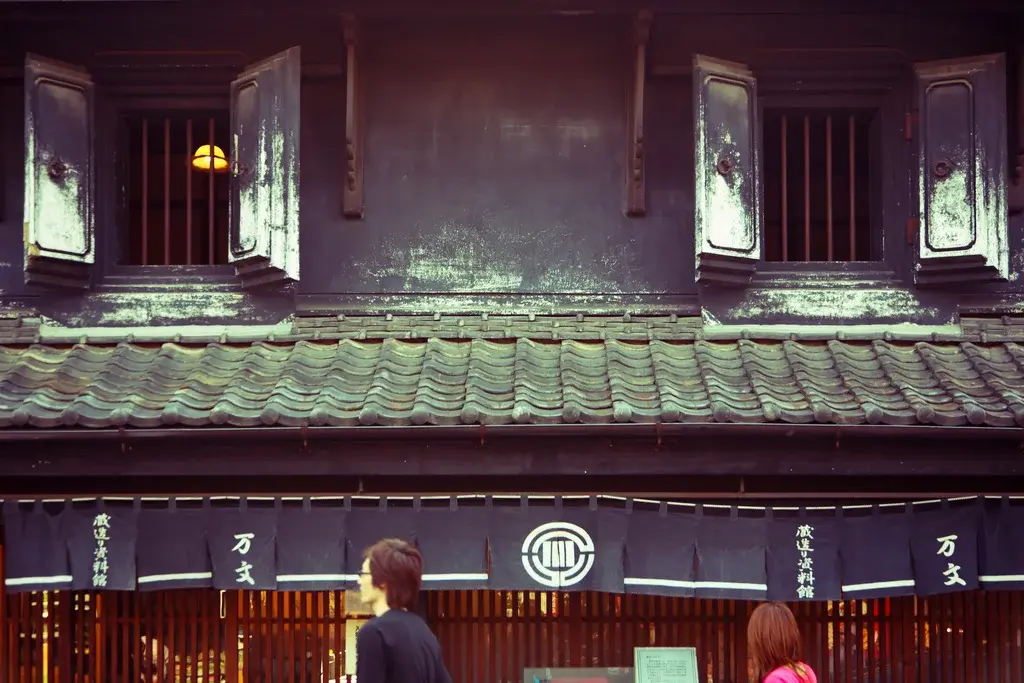
The walk leads you into Kawagoe's kurazukuri quarter, a stretch of black-walled merchant warehouses raised in the late Edo period and kept standing because they were the only buildings on the street to survive the fire of 1893. Walking the lane feels closer to nineteenth-century Edo than to modern Tokyo, and the tile-roofed silhouette of the district gave Kawagoe its nickname Little Edo.

A short detour brings you to Matsumoto Shoyu, a soy-sauce house in continuous operation for more than 250 years (the workshop is open to visitors on certain days only), and to Kashiya Yokocho, the Candy Alley, where some twenty old-fashioned sweet shops still hand-make rice-cracker, glass-marble, and stick-candy treats from family recipes.
❖ Koedo Kurari
15:35 - 15:50 (15 min)

Your day finishes at Koedo Kurari, a former sake brewery whose old timbers have been quietly converted into a tasting hall and craft shop. The original cedar beams and earthen walls have been kept intact, so the space still carries the cool, slightly fermented air of a working brewery.

Sample flights of Saitama craft sake at the counter, browse hand-thrown ceramics and indigo-dyed textiles from regional artisans, and pick up a few traditional sweets to take back. The walk from the door to your finish point at Honkawagoe Station is only a few minutes, an easy close to a day that began in the tea fields.
OPTIONS
Notes
The tour is bookable from May to November. From December to April it is out of service.
The tea-picking session lasts approximately one hour and takes place in an unshaded tea field, in small groups.
Long sleeves and long trousers are recommended: tea plants may touch your legs, and insect-repellent spray is advisable.
Wear shoes that you do not mind getting slightly dirty, as you will be walking through the fields.
Bring UV protection, a wide-brimmed hat, and sunscreen: there is no shade in the tea field.
On hot days, please bring a bottle of water to stay hydrated during the picking session.
Tea leaf tempura is served under a tent after the picking session; some sunlight may still filter through.
Meeting Point
Meet your guide at 09:30 at the east entrance of Iriso Station on the Seibu Ikebukuro Line. From central Tokyo, the journey takes approximately 50 minutes via Seibu Ikebukuro Line from Ikebukuro.
What's included:
Green tea picking experience
Traditional tea-picking costume
English-speaking guide
One-way transfer from Miyanoen to Iriso Station by car
One-way train ticket from Iriso Station to Honkawagoe Station
A cup of green tea and tea leaf tempura tasting
Photos of tour participants
Local tax
What's not included:
Hotel pick-up and drop-off
Train ticket to Iriso Station from your accommodation
Private experience
1
-
6
Participants
Saitama
From ¥16.000 /person
6 hours
Traveler Photos













From ¥16.000 /person
6 hours
Saitama